Written by SHERRY STEIN. Featured in Performances Magazine, broadstage, March 2026 Issue
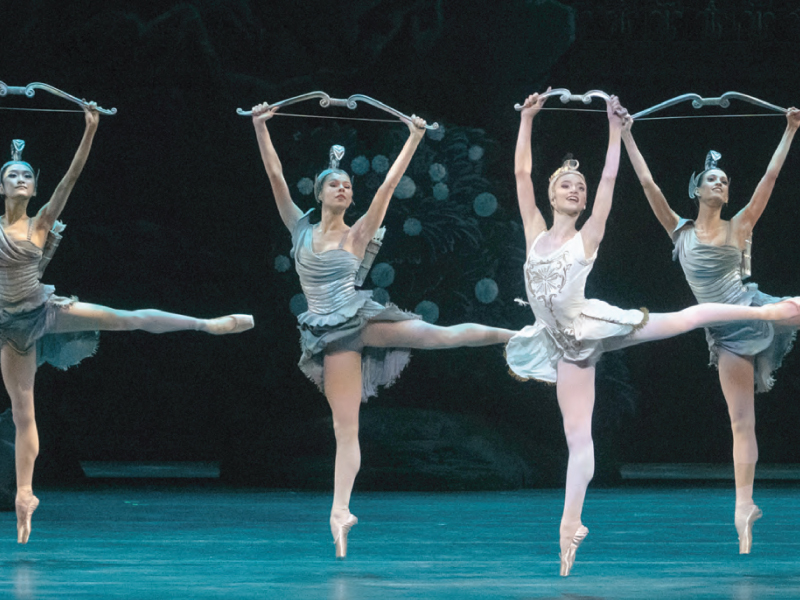
THE BALLERINA’S BEST friend, the pointe shoe, is familiar to anyone who has seen a ballet. Fabric slippers with a hard toe box, they allow a dancer to put full weight on the tips of her feet, lift herself with artistry and make leaps and turns beyond what’s humanly possible in conventional ballet flats. “You’re able to achieve certain feats—no pun intended —that you can only do in a pointe shoe. That’s what makes ballet and dance en point so unique,” says Melissa Barak, artistic director of Los Angeles Ballet and former dancer with New York City Ballet.
Classic pointe footwork will be richly available this spring with American Ballet Theatre’s Sylvia at Segerstrom Center for the Arts, Los Angeles Ballet’s Giselle at Ahmanson Theatre and New York City Ballet’s mixed repertory program at Dorothy Chandler Pavilion. Most in the audience will never know the long and almost ritualized journey those dancers’ toe shoes will have taken. Or that the shiny pair they see on a principal dancer’s feet likely won’t last the evening.
The pointe shoe’s history begins 200 years ago, when Italian and French ballerinas sought new ways to lift themselves, aiming to appear weightless and ethereal. Nineteenth-century dancers worked with cobblers who handcrafted shoes using newspaper, flour paste and pasteboard for the platform, then reinforced the cardboard insoles with leather. En pointe—the French phrase—was born.
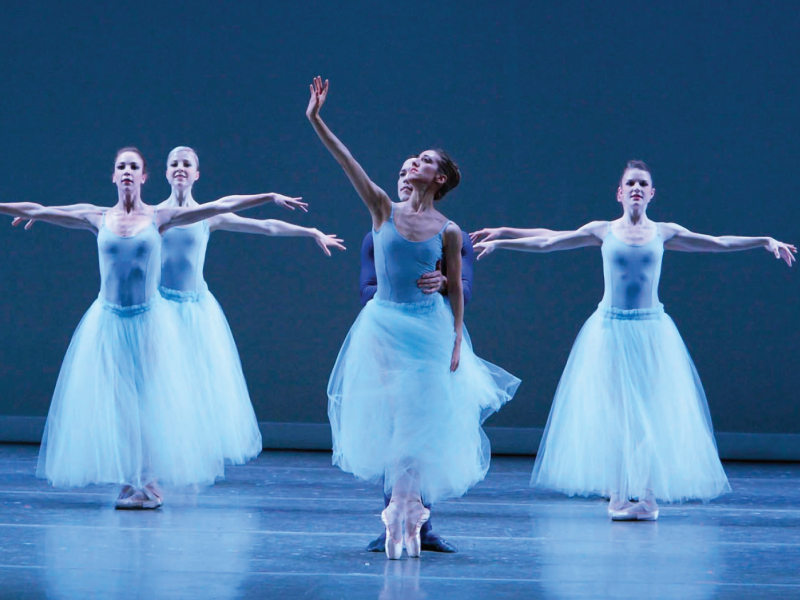
Two centuries later, that shoe-making process remains tried and true, says master pointe-shoe fitter Josephine Lee, CEO of The Pointe Shop in Southern and Northern California. Founded 12 years ago in Orange County, it is also the main pointe shoe fitter for San Francisco Ballet. “We specialize in a very small industry,” Lee says. The Pointe Shop carries dozens of shoe styles, each made by hand at eight factories around the world. “They still use the old-world technique,” Lee says. “They layer paste and paper and leather and satin and burlap to make them stronger. Then they hammer to shape the shoes.”
Companies offer styles using polymer or synthetics but the techniques remain as they were 100 years ago. Finding the right pointe shoe for a young ballerina is an involved—and sometimes never-ending—process that begins when she’s a pre-teen. But first comes hard work building strength and mastering technique.
Rosey Francis, an 8th grader who danced as Clara in ABT’s The Nutcracker in December, first went en pointe three years ago at age 10. “It’s crazy looking back at how young I was and how excited I felt,” she says.
That memorable moment was several years in the making at the American Ballet Theatre William J. Gillespie School at Segerstrom Center for the Arts; Rosey has trained there since she was 8. “About a year in advance to getting pointe shoes, we started having pre-pointe classes,” she remembers. The classes focused on ankle and foot strengthening. One day, a teacher assessed her and her fellow students to determine if they were strong enough to go on their toes. Each received an email the same day saying they were ready. “It was so special,” Rosey continues. “Our entire level are all really close buddies. We got the email and were all super-excited after class, hugging our parents.”
Then Lee visited the students at their studio, gave each a fitting, and they went en pointe for the first time. “It was magical,” Rosey recalls. “We had been looking up to the older dancers who got to do things en pointe and how beautiful their work was. We wore them all the time.” Lee’s job is to help each dancer find the shoe that fits her foot and her personal preferences.
“It’s as close to a custom shoe that you can get without actually being custom shoes,” Lee says. “It’s almost like getting fitted for a cast and you need to find the cast that fits the shape of your foot.”
Like many things these days, the price of a pointe shoe has skyrocketed. “It’s become very, very expensive,” Lee says. “In 2019, a pair was around $90 to $130. Now it could range anywhere from $110 to $180.” Pointe shoes are as fragile as they are sturdy. As the paste and materials break down from sweat and wear, the shoes lose their structural integrity.
For a large company, they represent a huge expense. ABT’s 60 female dancers go through 4,000 pairs a year, according to Tomoko Ueda-Dunbar, the troupe’s head of wardrobe and shoe manager. “Some dancers need a few pairs of shoes per show. Some go through a pair of shoes within a few hours of the rehearsal. It’s like a tissue—a hundred-dollar tissue just to blow your nose,” she says with a laugh.
The company spends approximately $500,000 a year on pointe shoes. Like many dance companies, ABT appeals to supporters to donate to its Pointe Shoe Fund. Ueda-Dunbar oversees ABT’s pointe shoe room, where she tracks dancers’ preferences, orders the shoes and keeps them organized so that everyone has a bin where they can swoop in to pick up their latest supply.
Tiler Peck, a principal dancer with New York City Ballet, performed as the Sugar Plum Fairy in The Nutcracker a dozen times over the last holiday season in New York and in Southern California with the Festival Ballet Theater, Westside Ballet and Pacific Festival Ballet. Afterwards, she went online and counted 25 pairs of shoes that she’d used in those performances. “Why do we wear so many shoes? It’s because during the Sugar Plum I wear two pairs … one for the variation and then one for the pas de [deux]. That’s sometimes two pairs for one performance,” she shared on Instagram.
For a top dancer such as Peck, once a shoe is declared dead it can still have an afterlife. She often autographs them and leaves the shoes at the stage door for kids. A ballet company buys the shoes for its pros. But for parents, keeping their daughter in pointe shoes can break the bank, Lee acknowledges. “That’s why we’re trying to make the shoe last.”
Rosey Francis might go through a pair every month or two. “You want to keep the shoe alive for as long as possible,” she says. “It’s less about getting the perfect fit all of the time, more about making the shoe last and building strength.” The harder shoes last longer and give a dancer more support. A softer one allows for more movement.
“I want my dancers to find that fine line between feeling comfortable and not feeling like they’re hurting their bodies in any way,” Barak says. “It’s about finding a shoe that’s form-fitting and that really works for them. I think both are achievable—finding a shoe that looks good and that functions the way you need it to. It doesn’t have to be a death device.”
Even with customizing, dancers bend and tweak every pair as part of the process to meet their needs for comfort and danceability. “When you’re a professional dancer, you can get up to 12 pairs of pointe shoes a month, and you’re breaking them into their perfect spot,” Lee says.
No two dancers manipulate their shoes in the same way. When a bag of fresh pink pointe shoes is delivered to ABT principal dancer Isabella Boylston, she rolls back the heels of each shoe and tears out much of the inner sole. Next, she puts the shoes down and uses her heel to smash the toe area. “It’s a very satisfying crunch,” Boylston says on her YouTube channel.
As part of Tiler Peck’s prep, she pinpoints a sweet spot on the bottom of each shoe and whacks them severely on the floor to make the shoe quieter during a performance. ABT dancer Skylar Brandt takes a Home Depot box cutter to the inside of her custommade Capezios and slices off more than half of the shank; it’s part of the breaking-in process she refers to as “bonding with her shoe.”
Dancers then sew their own ribbons to their shoes, which will wrap or crisscross around their ankles to keep the shoes stable and from slipping off. The ribbons both prevent injury and enhance the shoe’s aesthetics. Some dancers choose satin material, some prefer elastic, others use a combination. They might sew with a special thread or opt for drugstore dental floss, which doesn’t break. Some tuck the ribbon inside of the shoe for a cleaner look; others sew it on the outside so there’s nothing rubbing against the foot. With trial and error, each dancer finds her favored approach.
The process can be tedious when they’re going through five shoes a week. As Boylston puts it, “Sewing is basically the bane of every ballerina’s existence.” Even with all the planning before a show, a dancer needs to make sure she has the best shoe for the circumstance. “I see a lot of dancers warming up backstage right before their performance, and they will have a couple pair of pointe shoes and just keep trying and trying different pairs,” Ueda-Dunbar says.
Her job also includes painting or dying shoes to match tights and costumes. For dancers showing their bare legs, she dyes shoes to match the ballerina’s skin tone. That’s a change from when she started in the business 14 years ago. “Back then, shoes were the skin color of the dancers,” she says. “But over the last five, six years, maybe a little longer, came the movement of dancers with color. They said, ‘These are not our colors. We want to wear our colors.’” Some women of color mastered a technique called pancaking, using foundation makeup to match their skin tone and enhance the lines of their movements.
Pancaked shoes worn by Misty Copeland, ABT’s first African American principal dancer, and Stella Abrera, its first Filipina American, are in the Smithsonian’s American History Museum.
The pointe shoe is key to what made Rosey Francis first love ballet when she was 8. It’s not simply what the shoe is, it’s what it can help a dancer achieve, she says. “I love ballet because it really combines art with all the hard work that goes into it. There’s so much discipline, but then you can make it your own. There’s so much artistry that goes with it. That creative aspect is what pulled me in.”
Read the rest of the issue: Performances Magazine | broadstage, March 2026
Photo credits: Photo courtesy of Performances Magazine | broadstage, February 2026